Best Practices
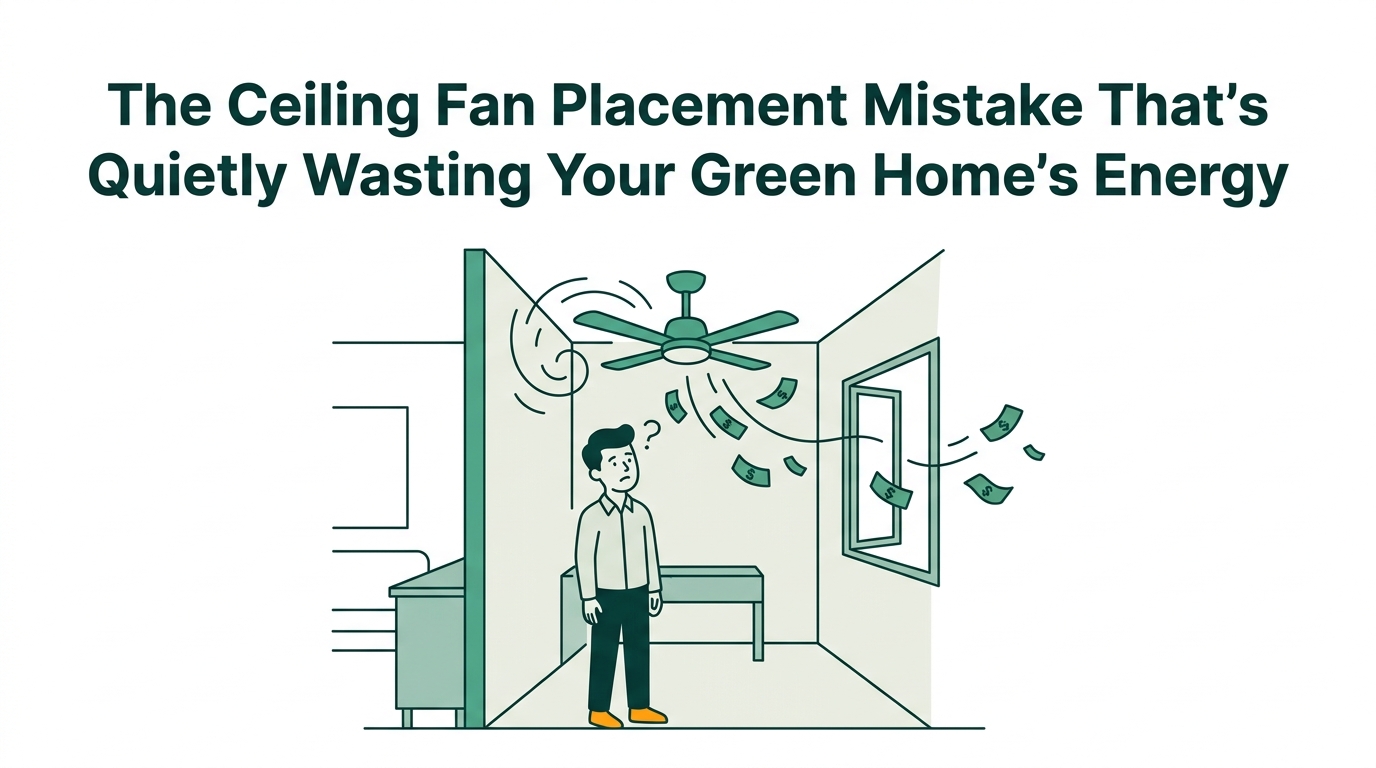
The Ceiling Fan Placement Mistake Quietly Wasting Your Green Home’s Energy

Proper ceiling fan placement directly influences your home’s thermal comfort and electrical load, yet it remains one of the most frequently overlooked details in sustainable residential design. Most homeowners focused on energy efficiency prioritize major upgrades like insulation or solar panels while ignoring where air movement devices are mounted. That small oversight can quietly cancel out a portion of your overall energy savings.
You might assume a fan is simple to install anywhere. Hang it, flip the switch, and consider it done. In a green home where every design choice must coordinate to reduce waste, a poorly positioned unit forces your cooling systems to work harder than necessary.
Why Fan Placement Matters More Than Blade Span
The core efficiency of installing a ceiling fan depends entirely on spatial geometry rather than motor wattage alone. A fixture mounted too close to a side wall creates uneven airflow drag. A device centered awkwardly in a long, narrow room fails to circulate air through the occupied zone. A unit hung too high beneath a vaulted ceiling loses its wind-chill effect entirely before reaching floor level.
This hardware requires proper positioning to perform as intended. A manufacturer like Hunter Fan builds motors and blade pitches to move air effectively, but that engineering breaks down if the fixture sits in dead air space. Good hardware and smart placement must work in tandem to reduce your overall carbon footprint.
Treating Air Circulation as Part of Your Whole Home Energy System
The larger mistake happens when homeowners treat air circulation as a decorative afterthought rather than a core component of sustainable facility management. In a truly energy-efficient home, your cooling units should align with your thermal envelope, windows, and HVAC setup from the start. If your wall insulation is installed correctly and your windows are sealed tightly, a well-positioned unit needs far less electrical draw to keep rooms comfortable.
A simple way to start is by mapping out room air currents before purchasing fixtures. Identify where occupants sit and where heat pockets form. Answering those layout questions first makes every subsequent hardware choice far more effective.
The Overlooked Science Behind Airflow Efficiency
Fan efficiency is measured in cubic feet of air moved per watt of electricity used, commonly referred to as CFM per watt. Mounting height directly alters this ratio because restricted intake clearance starves the blades of air. According to testing data on fan efficiency labels, airflow performance ranges from roughly 35 CFM per watt on low-efficiency models up to over 100 CFM per watt on high-efficiency options. That massive operational gap dictates whether your fixtures actively lower your power bill or just add ambient noise.
Checking the CFM per watt rating on product specifications helps you avoid poorly optimized models. Plan your downrod length so the blades hang roughly eight to nine feet above the floor for maximum wind-chill effect. It costs nothing extra during installation and noticeably shifts your operational energy use.
A Small Fix with a Real Payoff
Sustainable construction often emphasizes expensive capital investments like geothermal systems and high-performance glazing. However, optimizing your layout requires zero extra material cost, just careful planning. In a residence already designed to minimize waste, thoughtful placement ensures your appliances pull their weight without hidden energy penalties.



The Ceiling Fan Placement Mistake Quietly Wasting Your Green Home’s Energy

7 Benefits of Poured-in-Place Rubber Safety Surfacing for Commercial Building Playground Projects

Hidden Condensation in Homes: How Insulation, Airtightness and Moisture Testing Reveal the Risk

How Your Lawn Is Quietly Harming the Environment (And What to Do About It)

Why Sustainable Elevator Maintenance Matters for Green Buildings

Is Your Compressed Air System Sabotaging Your Facility’s Energy Performance Rating?

How Dirty Air Ducts Harm the Planet and Your Health

Sustainable Revegetation Solutions That Revitalise Victorian Landscapes

The Future of Construction: Eco-Friendly Materials and Methods

Eco-Friendly Shifts in Local Real Estate

How Green Contractors Can Boost Productivity and Sustainability

How Precision Cutting Protects Sustainable Materials
How Dirty Air Ducts Harm the Planet and Your Health
Sustainable Revegetation Solutions That Revitalise Victorian Landscapes
The Future of Construction: Eco-Friendly Materials and Methods
Eco-Friendly Shifts in Local Real Estate
How Green Contractors Can Boost Productivity and Sustainability
How Precision Cutting Protects Sustainable Materials
-
 Best Practices11 months ago
The Future of Construction: Eco-Friendly Materials and Methods
-
 Best Practices11 months ago
How Green Contractors Can Boost Productivity and Sustainability
-
 Best Practices10 months ago
How Precision Cutting Protects Sustainable Materials
-

 Best Practices9 months ago
How Natural Materials Are Shaping the Future of Green Interior Design
-
 News11 months ago
Why Green Contractors Must Use Mold-Resistant Boards
-

 Construction7 months ago
Top Energy Solutions for Making Eco-Friendly Homes
-

 Sustainability9 months ago
Eco-Smart Construction: How Reusable Site Equipment Drives Sustainability
-

 Best Practices11 months ago
Eco-Friendly Contractors Need the Right Jackets for the Job